


















Private DNA insights for healthy-ageing and genomic context
Biological Age & DNA Health Test Home Kits UK
Compare an epigenetic biological-age test with genome-wide DNA genotyping before choosing the private home kit that matches the question you want to explore.
These tests examine different layers of biology. DNA methylation testing estimates age-related epigenetic patterns, while genotyping looks at inherited DNA variants included on an array. Neither should be treated as a diagnosis, a prediction of lifespan or a substitute for clinical genetic testing.

Seek clinical advice if you have symptoms, a strong family history, a known inherited condition in the family, a pregnancy-related genetic concern or a result that could materially affect medical care.
Interactive test finder
What would you like the test to explore?
Select the closest question. This tool helps with navigation only and does not assess disease risk or recommend medical testing.
Understand the difference first
Epigenetic age testing and genotyping are not interchangeable
Examines DNA methylation patterns at selected sites and applies an age-estimation algorithm. Methylation is an epigenetic layer associated with gene regulation and may vary with tissue, age, exposures and other biological factors.
Best viewed as an estimated biomarker output, not a literal measure of how old every organ is.Measures selected inherited DNA variants across the genome using an array. It can support reports about common variants and traits included in the test, but it is not the same as sequencing every DNA letter.
A negative result does not exclude variants the array did not test.DNA methylation patterns may differ over time and between sample types. Your inherited genotype is generally stable, although the meaning assigned to variants can evolve as research and databases are updated.
Common reasons for comparing DNA health tests
Start with the question, not the number of data points
The Grace Belgravia experience
Private testing with context before conclusions

Product selection should begin with test scope, report type, limitations and data handling rather than a headline promise.

DNA information can be personal, persistent and relevant to biological relatives, so consent deserves careful attention.
Browse the collection
Biological age and DNA health test home kits

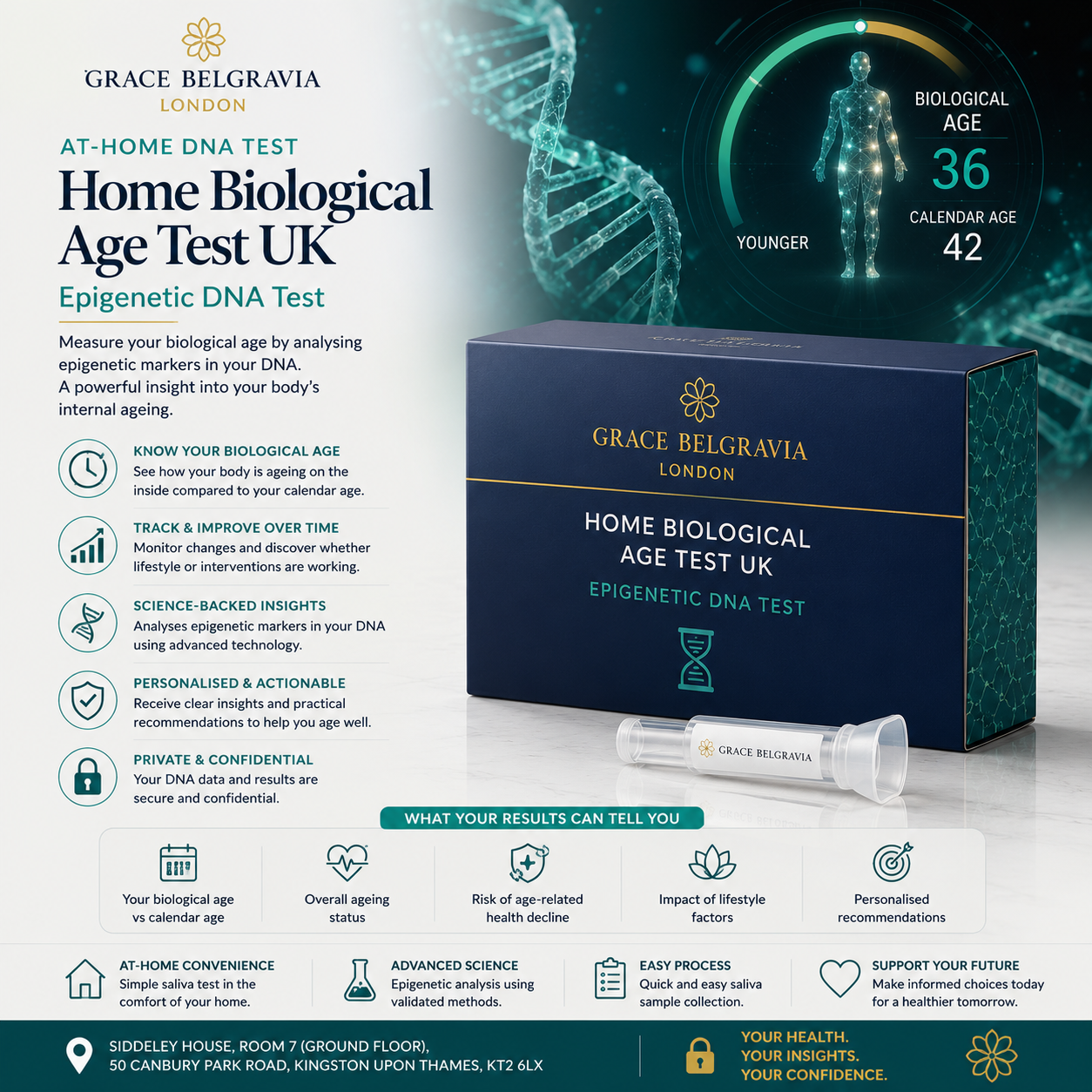
Home Biological Age Test UK – Epigenetic DNA Test
Designed for people seeking an estimated biological-age output derived from age-associated DNA methylation patterns. The report should be interpreted as an algorithmic biomarker estimate rather than a diagnosis or prediction of lifespan.

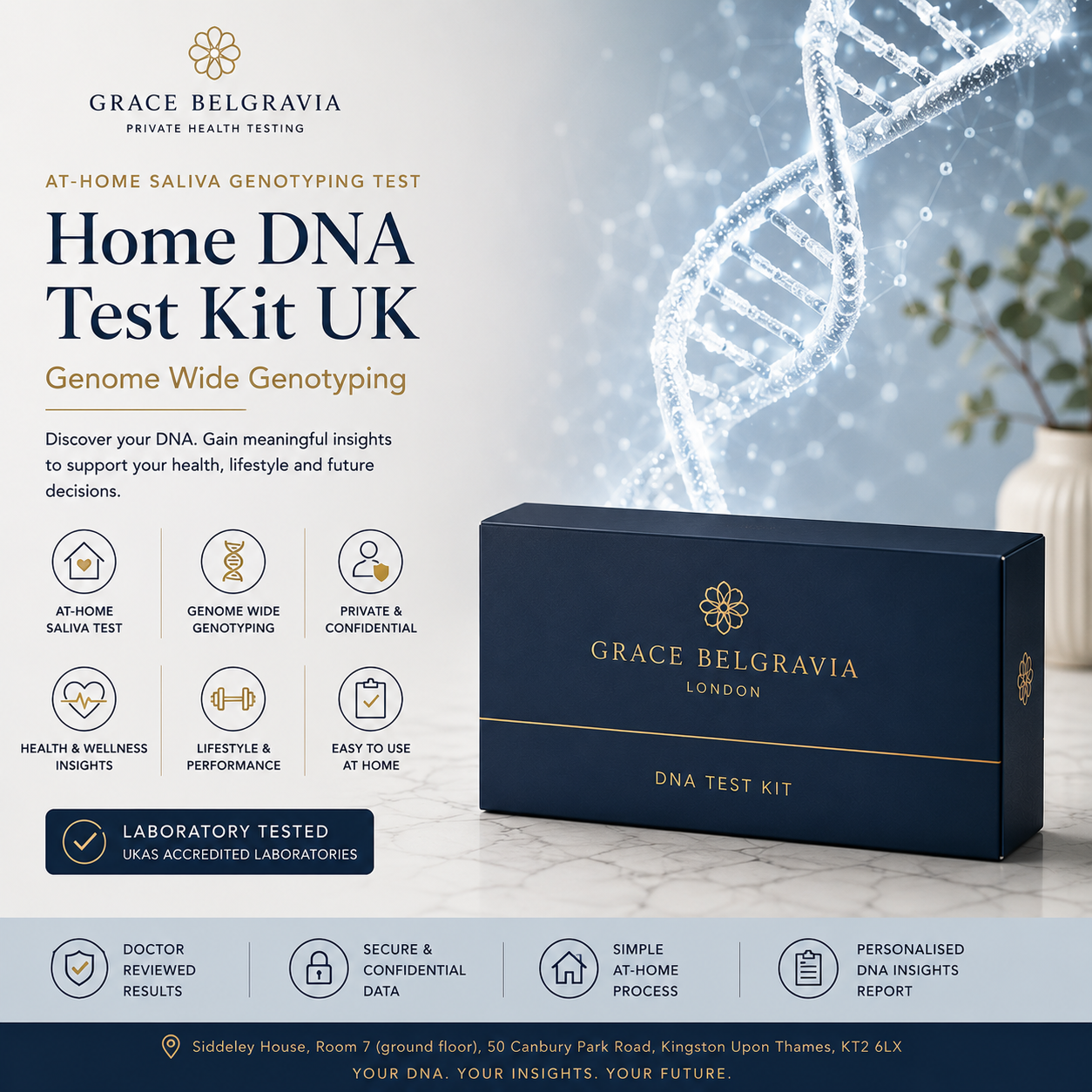
Home DNA Test Kit UK – Genome Wide Genotyping
Uses a genome-wide genotyping array to measure selected DNA variants included on the platform. It is suited to common-variant and trait context covered by the report, but it is not whole-genome sequencing and should not be used to confirm a rare disease-causing variant.
Side-by-side guide
Compare biological age and DNA health tests
| Feature | Epigenetic Biological Age Test | Genome-Wide Genotyping Test |
|---|---|---|
| Main question | What age-related DNA methylation pattern does the model estimate? | Which selected inherited DNA variants are detected on the array? |
| Biological layer | Epigenetic marks associated with regulation | Inherited DNA sequence variation |
| May vary over time? | Potentially, depending on biology, sample and analytical method | Your genotype is generally stable; interpretation may change |
| Useful for | Ageing-biomarker context and careful longitudinal interest | Common-variant and trait reports within the tested scope |
| Not designed to | Predict exact lifespan or diagnose a disease | Replace clinical sequencing or exclude untested variants |
| Before ordering | Check clock, sample, repeatability and reporting method | Check variant scope, report categories and data policy |
Epigenetic Biological Age Test
Genome-Wide Genotyping Test
Plain-English glossary
DNA and biological-age terms explained
DNA methylation
A chemical mark commonly added at particular DNA sites. It can influence or reflect gene regulation without changing the underlying DNA sequence.
Epigenetic clock
An algorithm that uses methylation values at selected sites to estimate age-related biological patterns. Different clocks were developed for different research purposes and may not give identical outputs.
Chronological age
The time elapsed since birth. It is fixed by date and is different from an estimated biological or epigenetic age.
Age acceleration
A research term describing whether an epigenetic-age estimate is higher or lower than expected after comparison with chronological age or another model. It should not be read as literal years gained or lost.
CpG site
A location where cytosine is followed by guanine in the DNA sequence. Many methylation studies measure marks at selected CpG sites.
SNP
A single-nucleotide polymorphism is a common difference at one position in the DNA sequence. A genotyping array measures selected variants, including many SNPs.
Genotyping array
A laboratory platform designed to detect a predefined set of DNA variants. It does not read every base in the genome.
Whole-genome sequencing
A different technology intended to sequence genetic material across the genome. A genome-wide genotyping array should not be described as whole-genome sequencing.
Polygenic score
A statistical estimate that combines information from many variants. Its performance can depend on the population used to develop it, the outcome studied and the quality of the underlying evidence.
Clinical confirmation
Additional testing through an appropriate accredited clinical pathway when a result could influence diagnosis, screening, treatment or family care.
Privacy, consent and future use
Questions to ask before sharing a DNA sample
In the UK, genetic and health information falls within special-category personal data. Read the applicable privacy notice and consent terms rather than assuming that every DNA-testing service handles data in the same way.
How the home-testing pathway works
From product choice to responsible interpretation
Choose the question
Select epigenetic-age context or inherited-variant information rather than simply choosing the broader-looking report.
Read scope and consent
Check technology, sample requirements, data storage, report categories and stated limitations.
Collect carefully
Use the equipment and collection instructions supplied with the individual test.
Laboratory analysis
The sample follows the assay-specific laboratory pathway and quality-control process.
Review the report
Separate measured data from algorithmic estimates, associations and educational interpretation.
Confirm important findings
Do not make high-impact medical decisions from a consumer result without an appropriate clinical pathway.
Laboratory and testing standards
Technology-specific analysis with transparent boundaries
DNA methylation and genotyping use different laboratory and computational methods. The individual product specification should identify the sample type, assay, reporting pathway and applicable quality standards.
- Sample identity and acceptance checks
- Assay-specific controls and data-quality review
- Defined test scope and report methodology
- Secure digital reporting and controlled access
- Clear escalation where a finding requires clinical confirmation
Accreditation and regulatory status can differ between tests and pathways. Check the current individual product specification before ordering.

Interpreting results responsibly
What to do with the information
Contact an appropriate healthcare professional if you are unwell, have a known familial genetic condition, are planning a pregnancy with an inherited-risk concern or need a result to guide treatment or screening.
Medical and editorial review
Medically checked DNA and healthy-ageing guidance
The collection has been reviewed for responsible presentation of epigenetic-age estimates, genotyping limits, privacy considerations, clinical confirmation and consumer-facing medical boundaries.

Dr Laura Geige
Medical Director, Senior Practitioner and Skin Expert
Reviewed consumer medical boundaries, clinical escalation, high-impact result wording and the distinction between educational reports and diagnostic testing.
View professional profile
Dr Rimas Geiga
Medical Doctor, Nutritional Sciences Adviser and Healthy Ageing Expert
Reviewed biological-age terminology, lifestyle context, limits of age acceleration and responsible interpretation of epigenetic biomarkers.
View professional profile
Veronika Matutyte
Medical Doctor and Healthcare Management Expert
Reviewed laboratory-pathway language, consent, genetic-data sensitivity, privacy prompts and confirmatory-testing safeguards.
View professional profileAuthoritative references
UK, university and peer-reviewed DNA testing sources
UK clinical, privacy and consumer guidance
UK university research
Foundational and methodological publications
Frequently asked questions
Biological age and DNA health test FAQs
What is a biological age test?
A biological age test estimates an age-related biological pattern using a defined method. This collection’s epigenetic test uses DNA methylation information and an algorithm; it does not directly measure the age of every organ.
Is biological age the same as chronological age?
No. Chronological age is time since birth. Biological or epigenetic age is a model-derived estimate based on selected biological measurements.
Can an epigenetic test predict how long I will live?
No. Research has associated some epigenetic measures with health outcomes at population level, but an individual result cannot predict exact lifespan.
Can my epigenetic age change?
DNA methylation patterns can differ over time, but apparent changes may also reflect sample type, laboratory method, algorithm, data processing and ordinary measurement variation.
Can I compare results from two different biological-age companies?
Not reliably without understanding whether they use the same sample type, laboratory platform, quality controls, clock and reporting method.
What is genome-wide genotyping?
It uses an array to measure selected DNA variants distributed across the genome. The exact variants and report categories depend on the platform and product specification.
Is a genotyping array the same as whole-genome sequencing?
No. An array checks predefined locations, while whole-genome sequencing aims to read genetic material across the genome.
Can a home DNA test diagnose an inherited disease?
No. A consumer genotyping result should not be used to diagnose or exclude an inherited condition. Clinical assessment and confirmatory testing may be needed.
What should I do if a rare or serious variant is reported?
Do not change medical care on the basis of a consumer array or raw-data interpretation. Discuss the finding with an appropriate healthcare professional or clinical genetics service.
Which test should I choose?
Choose the epigenetic test for an age-related methylation estimate and the genotyping test for inherited-variant context within the array’s scope. Choose neither as a substitute for clinical genetic investigation.
What should I check in the privacy policy?
Review sample storage, raw-data retention, deletion, research use, international transfers, third-party access, reanalysis and whether consent can be withdrawn.
Can DNA results affect my family?
Potentially. Inherited DNA information may have implications for biological relatives and can reveal unexpected family information.
Can genetic testing affect insurance in the UK?
UK rules are governed by the current Code on Genetic Testing and Insurance and the circumstances of the application. Review current government and insurer guidance rather than relying on a general assumption.
Can I change medication or supplements based on the result?
Do not start, stop or alter prescribed treatment on the basis of a consumer DNA or biological-age report without appropriate medical advice.
Are these collection materials medically reviewed?
This collection guide has named medical and quality reviewers. The review process for an individual laboratory report depends on the specific product pathway.