



















At home kidney blood test
Home Kidney Function Test UK | eGFR & Creatinine
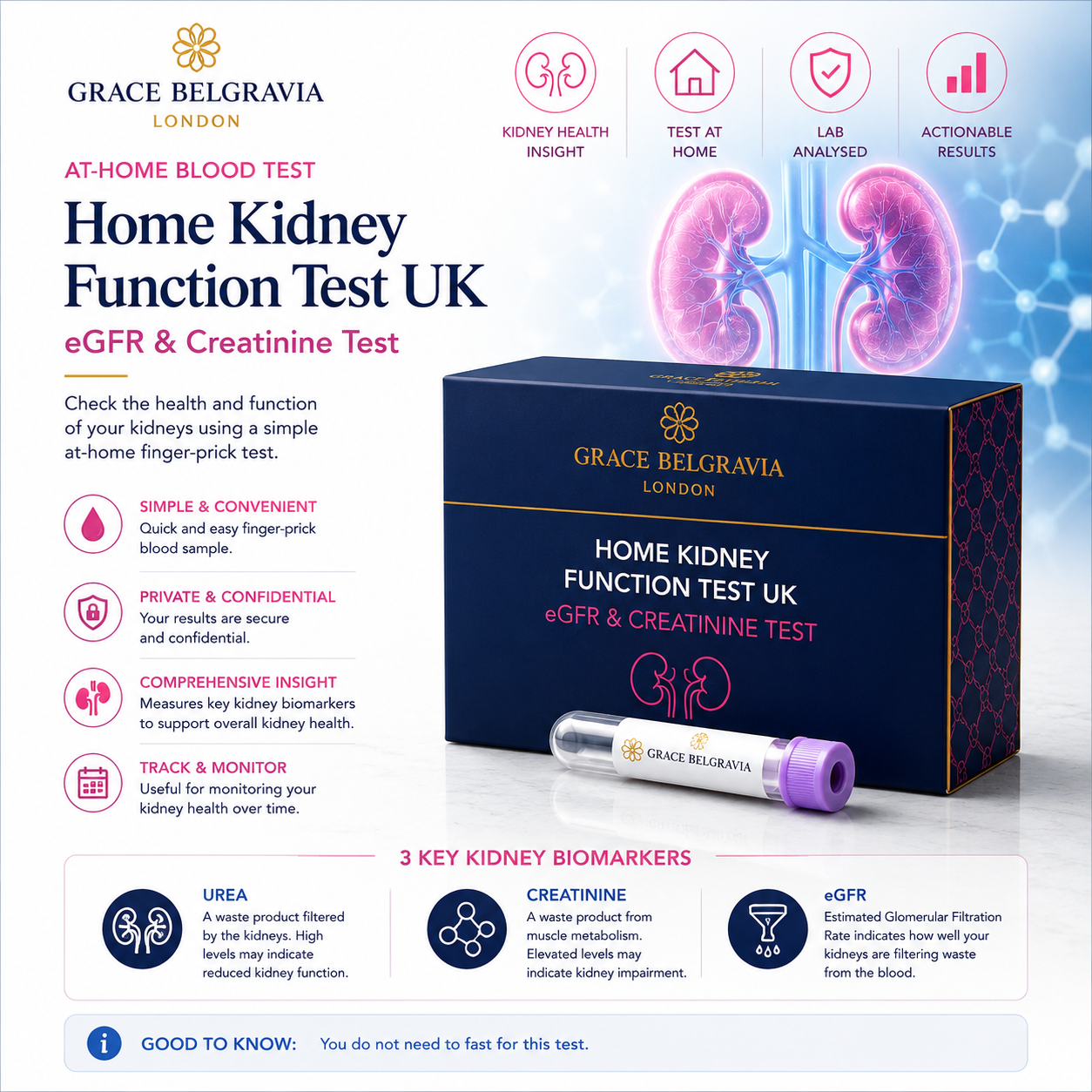
A three marker home blood test measuring urea and creatinine and calculating eGFR through a UK laboratory pathway.
The panel provides selected information about kidney filtration and waste handling. Results should be interpreted with hydration, muscle mass, medicines, previous values and urine testing.
This product does not include urine albumin to creatinine ratio, urinalysis, sodium, potassium, chloride, bicarbonate, cystatin C or imaging. Chronic kidney disease is assessed using both blood and urine information over time.
Seek urgent help for a major reduction in urine output, severe vomiting or dehydration, confusion, collapse, breathlessness with swelling, blood in the urine with severe pain, or feeling acutely unwell.
Quality and compliance
Home kidney testing supported by UK standards
What this kidney function test measures
| Marker | What it represents | Important limitation |
|---|---|---|
| Urea | A product of protein metabolism removed mainly by the kidneys. | Strongly affected by hydration, protein intake, liver function and illness. |
| Creatinine | A muscle metabolism product used to estimate kidney filtration. | Affected by muscle mass, diet, exercise, supplements and medicines. |
| eGFR | A calculated estimate of glomerular filtration. | Not a direct measurement and does not identify urine protein loss. |
Who may consider this test?
This home kidney function test may be considered by adults seeking selected kidney filtration information in the context of:
- Diabetes or high blood pressure
- Cardiovascular disease or a family history of kidney disease
- An earlier high creatinine or low eGFR result
- Medicines that require clinician directed kidney monitoring
- Recurrent dehydration, kidney stones or urinary problems
- A request from a GP or another qualified clinician
People at risk of chronic kidney disease commonly need both eGFR and urine ACR testing rather than blood testing alone.
Understanding eGFR categories
These categories support clinical classification. A single result does not usually diagnose chronic kidney disease.
| Category | eGFR mL/min/1.73m² | General interpretation |
|---|---|---|
| G1 | 90 or above | Normal or high filtration. CKD requires another marker of kidney damage. |
| G2 | 60 to 89 | Mildly reduced. May be age related without another abnormal marker. |
| G3a | 45 to 59 | Mild to moderate reduction. |
| G3b | 30 to 44 | Moderate to severe reduction. |
| G4 | 15 to 29 | Severe reduction. |
| G5 | Below 15 | Kidney failure range and urgent clinical assessment required. |
How the home kidney blood test works
Review preparation
Record hydration, illness, exercise, medicines, supplements and previous kidney results.
Collect and return
Collect capillary blood into the supplied microtainer and return it using the provided packaging.
Review the trend and urine context
Interpret urea, creatinine and eGFR with previous results, blood pressure and urine ACR where appropriate.
Preparing for the test
| Preparation | What to do |
|---|---|
| Fasting | Fasting is not generally required. Follow the supplied kit instructions. |
| Hydration | Maintain normal hydration. Avoid testing when significantly dehydrated where routine testing can safely be delayed. |
| Cooked meat | An unusually large cooked meat meal can temporarily raise creatinine. Keep preparation consistent when comparing results. |
| Exercise | Avoid unusually strenuous exercise before collection because muscle injury can raise creatinine. |
| Supplements | Record creatine, protein and bodybuilding supplements. |
| Medicines | Record NSAIDs, ACE inhibitors, ARBs, diuretics, trimethoprim and other relevant medicines. Do not stop treatment yourself. |
| Recent illness | Vomiting, diarrhoea, fever, infection or acute illness can alter kidney results and may require clinical assessment. |
| Pregnancy | Creatinine and eGFR require specialist interpretation in pregnancy, and standard eGFR equations are not validated for routine use. |
Common kidney result patterns
These simplified patterns support discussion and are not diagnoses.
| Pattern | Possible context | Possible next step |
|---|---|---|
| High creatinine with low eGFR | May reflect reduced kidney filtration, dehydration, acute illness, medicines or muscle related factors. | Repeat promptly where advised and review urine ACR, medicines and previous results. |
| High urea with relatively stable creatinine | May occur with dehydration, high protein intake, gastrointestinal bleeding or tissue breakdown. | Review symptoms, hydration, diet and clinical context. |
| eGFR 60 to 89 without urine abnormality | May be compatible with ageing or normal variation. | CKD is not diagnosed without persistence or another marker of kidney damage. |
| Normal eGFR with raised urine ACR | Kidney damage may be present despite preserved filtration. | This blood panel does not measure ACR, so urine testing may be needed. |
| Rapid fall from a previous eGFR | May indicate acute kidney injury even if the current number is not extremely low. | Seek prompt clinical assessment. |
Biomarkers and result interpretation
Select each marker to read what it measures, preparation guidance and how low, normal, high or urgent results may be considered.
Urea
Urea is produced in the liver during protein metabolism and is removed mainly by the kidneys. Its blood concentration depends on kidney filtration, hydration, protein intake, tissue breakdown, liver urea production and gastrointestinal bleeding.
Urea is less specific for kidney filtration than creatinine and eGFR. It should be interpreted with the complete pattern and clinical context.
Fasting is not generally required. Maintain normal hydration and record recent vomiting, diarrhoea, fever, strenuous exercise, muscle injury, cooked meat intake, creatine supplements and medicines including NSAIDs, ACE inhibitors, ARBs, diuretics and trimethoprim. Do not stop prescribed treatment yourself.
How to understand this result
| Result | What it may mean | What to do |
|---|---|---|
| Critical low | A markedly low result is uncommon and may reflect severe liver dysfunction, overhydration, very low protein intake or another serious condition. | Follow the laboratory advice and arrange clinical review when unexpected or accompanied by symptoms. |
| Low | May occur with low protein intake, pregnancy, overhydration, malnutrition or reduced liver urea production. | Discuss a persistent or unexpected result with a GP. |
| Normal | Falls within the laboratory reference interval. | A normal urea does not prove that kidney function is normal. |
| High | May occur with dehydration, reduced kidney filtration, high protein intake, gastrointestinal bleeding, severe illness, tissue breakdown or medicines. | Review hydration, creatinine, eGFR, symptoms and medicines with a clinician. |
| Critical high | A markedly raised result may accompany severe dehydration, acute kidney injury, advanced kidney impairment or gastrointestinal bleeding. | Seek prompt medical assessment and follow the laboratory escalation advice. |
Creatinine
Creatinine is produced from normal muscle metabolism and removed mainly by kidney filtration. It is the blood marker used to calculate eGFR.
Creatinine is affected by muscle mass, age, body size, diet, exercise, supplements and some medicines. A value that is normal for one person may be abnormal for another, so trends and eGFR are important.
Fasting is not generally required. Maintain normal hydration and record recent vomiting, diarrhoea, fever, strenuous exercise, muscle injury, cooked meat intake, creatine supplements and medicines including NSAIDs, ACE inhibitors, ARBs, diuretics and trimethoprim. Do not stop prescribed treatment yourself.
How to understand this result
| Result | What it may mean | What to do |
|---|---|---|
| Low | Often reflects lower muscle mass, small body size, pregnancy, malnutrition or reduced creatine production. | Interpret it with body composition, diet and the calculated eGFR. |
| Normal | Falls within the laboratory interval. | A normal creatinine does not exclude early kidney disease or urine albumin loss. |
| High | May reflect reduced kidney filtration, dehydration, muscle injury, strenuous exercise, creatine use, recent cooked meat or medicines that alter creatinine handling. | Discuss the result, trend, eGFR, hydration and medicines with a GP. |
| Critical high | A markedly raised result may indicate significant acute or chronic kidney impairment, severe dehydration or major muscle injury. | Seek prompt medical assessment and follow the laboratory's urgent advice. |
Estimated glomerular filtration rate (eGFR)
eGFR is calculated from creatinine and demographic information to estimate kidney filtration. It is usually reported in mL/min/1.73m².
eGFR is most useful as a trend. Chronic kidney disease is classified using both eGFR and urine albumin to creatinine ratio, and an abnormality usually needs to persist for at least three months.
Creatinine based eGFR can be less reliable during acute kidney injury, pregnancy, severe illness, unusual muscle mass, amputations, malnutrition, bodybuilding or creatine use. It is not a direct measurement of filtration.
Fasting is not generally required. Maintain normal hydration and record recent vomiting, diarrhoea, fever, strenuous exercise, muscle injury, cooked meat intake, creatine supplements and medicines including NSAIDs, ACE inhibitors, ARBs, diuretics and trimethoprim. Do not stop prescribed treatment yourself.
How to understand this result
| Result | What it may mean | What to do |
|---|---|---|
| G1: 90 or above | Usually represents normal or high filtration. Kidney disease can still be present if urine albumin, blood, imaging or another marker is abnormal. | Consider urine ACR and risk factors where clinically appropriate. |
| G2: 60 to 89 | Mildly reduced filtration. This may be age related or clinically insignificant without another marker of kidney damage. | Compare with previous results and consider urine ACR. |
| G3a: 45 to 59 | Mild to moderate reduction in estimated filtration. | Arrange GP review, repeat testing and urine ACR assessment. |
| G3b: 30 to 44 | Moderate to severe reduction in estimated filtration. | Prompt clinical review and medication, blood pressure and complication assessment are appropriate. |
| G4: 15 to 29 | Severe reduction in estimated filtration. | Urgent specialist or GP review is generally required. |
| G5: below 15 | Kidney failure range, although interpretation still depends on clinical context and whether the change is acute or chronic. | Seek urgent medical assessment. |
| High | A high calculated eGFR may be normal, particularly in younger adults, or may occur with pregnancy or hyperfiltration. Accuracy is reduced at high values. | Discuss an unexpected result if diabetes, pregnancy or other risk factors are present. |
What this panel does not include
| Not included | Why it may matter |
|---|---|
| Urine albumin to creatinine ratio | Detects albumin leakage and is required with eGFR for CKD classification and risk assessment. |
| Urinalysis | May identify blood, protein, infection or other urinary abnormalities. |
| Sodium, potassium and bicarbonate | Important electrolytes that may become abnormal in kidney disease or with medicines. |
| Cystatin C | May help when creatinine based eGFR is uncertain or muscle mass makes interpretation difficult. |
| Kidney imaging | May be required for stones, obstruction, structural abnormalities or recurrent urinary problems. |
| Measured GFR or creatinine clearance | Used in selected specialist or medicine dosing situations where an estimate is insufficient. |
Evidence and content standards
How this product information was prepared
This page was prepared from the supplied three marker Kidney Function Test specification and checked against current NHS, NICE, UKAS and CQC information on creatinine, eGFR, CKD classification, urine ACR, acute kidney injury and laboratory limitations.
Clinical accountability
Kidney interpretation, medicine safety and metabolic context review
The review roles are separated across laboratory interpretation, medicine and patient safety, and metabolic risk context. The reviewers are not presented as consultant nephrologists.
Veronika Matutyte
Medical Doctor and Healthcare Management Expert
Reviewed eGFR categories, repeat testing, urine ACR limitations, acute kidney injury escalation and laboratory governance.
View professional profileDr Snieguole Geige
Dentist, Medical Doctor and Senior Adviser
Reviewed medicine disclosure, dehydration, urgent symptoms, clinical follow up and the distinction between home testing and diagnosis.
View professional profileDr Rimas Geiga
Medical Doctor, Nutritional Sciences Adviser and Healthy Ageing Expert
Reviewed diabetes, blood pressure, hydration, nutrition, muscle mass and healthy ageing factors affecting kidney blood results.
View professional profileAuthoritative references
UK kidney testing and laboratory sources
View the evidence sources used
- NHS: chronic kidney disease diagnosis and eGFR
- NICE NG203: chronic kidney disease assessment and management
- NICE CKS: eGFR and urine ACR classification
- NHS: urine albumin to creatinine ratio testing
- NHS pathology guidance on creatinine and eGFR limitations
- UKAS ISO 15189 medical laboratory accreditation information
- CQC guidance on diagnostic and screening procedures
Search led questions
Home kidney function test FAQs
Can I take a kidney function test at home?
Yes. This kit uses capillary blood collected at home and returned for laboratory analysis. It reports urea, creatinine and calculated eGFR, but it does not provide a complete kidney assessment by itself.
What does this kidney blood test measure?
The panel measures urea and creatinine and uses the creatinine result with demographic information to calculate estimated glomerular filtration rate, known as eGFR.
What is eGFR?
eGFR is an estimate of how much blood the kidneys filter each minute, standardised to a body surface area of 1.73 square metres. It is calculated rather than measured directly.
Can one eGFR result diagnose chronic kidney disease?
Usually not. Chronic kidney disease generally requires an abnormality to persist for at least three months or other evidence of kidney damage, such as an abnormal urine albumin to creatinine ratio.
What eGFR level is considered normal?
An eGFR of 90 or above is generally classified as G1. An eGFR of 60 to 89 is G2 and may be normal for some people, particularly with age, unless another marker of kidney damage is present.
What do the eGFR stages mean?
The usual adult categories are G1 at 90 or above, G2 at 60 to 89, G3a at 45 to 59, G3b at 30 to 44, G4 at 15 to 29 and G5 below 15 mL/min/1.73m². Diagnosis and risk also depend on urine ACR and persistence over time.
Does a low eGFR always mean kidney disease?
No. Dehydration, acute illness, medicines, recent strenuous exercise and creatinine related limitations can temporarily lower eGFR. A repeat test and urine ACR may be required.
Can eGFR be inaccurate?
Yes. Creatinine based eGFR may be less accurate in people with unusually high or low muscle mass, amputations, severe malnutrition, pregnancy, acute kidney injury, creatine use or recent cooked meat intake.
What does a high creatinine result mean?
High creatinine can occur with reduced kidney filtration, dehydration, muscle injury, strenuous exercise, creatine supplements, recent meat intake and some medicines. The trend and eGFR are more informative than one isolated result.
What does a low creatinine result mean?
Low creatinine often reflects lower muscle mass, small body size, pregnancy, malnutrition or reduced creatine production. It does not usually indicate kidney failure.
What does a high urea result mean?
High urea may occur with dehydration, reduced kidney filtration, high protein intake, gastrointestinal bleeding, severe illness, increased tissue breakdown or some medicines.
What does a low urea result mean?
Low urea may occur with low protein intake, overhydration, pregnancy, reduced liver urea production or malnutrition. It should be interpreted with creatinine, eGFR and clinical history.
Do I need to fast for a kidney function test?
Fasting is not generally required. Follow the kit instructions and avoid an unusually large cooked meat meal, creatine supplements and very strenuous exercise immediately before testing where practical.
How much water should I drink before the test?
Use normal hydration. Dehydration can raise urea and creatinine, while excessive water intake may dilute some results. Do not force large quantities of water.
Can exercise affect creatinine and eGFR?
Yes. Strenuous exercise and muscle injury can temporarily raise creatinine and lower calculated eGFR. Record recent intense exercise and consider delaying routine testing.
Can creatine supplements affect kidney blood results?
Creatine supplements can raise serum creatinine without necessarily representing a true reduction in filtration. Declare supplements and discuss an unexpected result with a clinician.
Can medicines affect kidney function results?
Yes. NSAIDs, ACE inhibitors, ARBs, diuretics, trimethoprim and other medicines can affect kidney function or creatinine interpretation. Do not stop prescribed medicines without medical advice.
Does this test include potassium and sodium?
No. It is not a complete urea and electrolytes profile. Sodium, potassium, chloride and bicarbonate are not included.
Does this test include a urine ACR test?
No. Urine albumin to creatinine ratio is an important test for kidney damage, particularly in diabetes, hypertension and chronic kidney disease risk assessment.
Can normal eGFR rule out kidney disease?
No. Early kidney disease may be present with a normal eGFR if urine albumin, blood in the urine, imaging or another marker is abnormal.
What happens after a low eGFR result?
A GP may repeat creatinine and eGFR, compare previous results, request urine ACR and urinalysis, review blood pressure and medicines, and check electrolytes or other causes.
When is a low eGFR urgent?
Urgency depends on the level, how quickly it changed, symptoms and potassium or other results. A very low result, a rapid fall or symptoms of acute kidney injury require prompt medical assessment.
What kidney symptoms need urgent medical attention?
Seek urgent help for a major reduction in urine output, severe vomiting or dehydration, confusion, collapse, breathlessness with swelling, blood in the urine with severe pain, or feeling acutely unwell.
Are the laboratories UKAS accredited and CQC registered?
Samples are processed through UKAS accredited laboratories within a CQC registered diagnostic pathway. Collection equipment is UKCA and CE marked and supported by an ISO 13485 quality management framework.